Score Overview
i
Marlow
iMarlow is practice management software for independent physiotherapy practices, combining scheduling, in-session notes and insurer-ready billing in one tool.
- Live in 11 practices across 3 countries since March 2026, with 6 named reference practices in NL, PL and DE
- Founder-market fit: CEO is a practicing physiotherapist who ran a four-therapist practice; CTO shipped v1 in six months; insurer claims-director advisor
- Clear, simple pricing (€89/practice/month + €19/extra therapist) with 80% gross margin assumption and a 2027 payments revenue line
Top Priority
iReplace the logo wall on slide 7 with a metrics slide: current MRR/ARR, how many of the 11 practices are paying vs in trial, trial-to-paid conversion rate, logo churn since March 2026, and a monthly cohort chart. Keep the six named references as a secondary strip, not the headline.
Competitive Landscape: 42/100
There is no competition slide at all; the only competitive reference is an indirect remark that dentists and GPs have had practice software for twenty years while physios mostly do not.
Target: 75+ / 100
Add a dedicated competition slide naming real alternatives (e.g. incumbent EU physio/practice suites, generic scheduling apps, paper + spreadsheet) and score each on setup time, tablet notes, and insurer claim coverage
Critical Red Flags
iAction Plan
i- 1
Replace logo wall with traction metrics
Slides 7medium effortActionRebuild slide 7 around hard numbers: MRR/ARR, how many of the 11 live practices are paying versus in 30-day trial, trial-to-paid conversion, logo churn since March 2026, and monthly adds. Demote the six named practices to a small reference strip.
Why it mattersBecause billing starts in month two of a free trial, an investor currently cannot tell whether any of the 11 practices are revenue - the single most important seed signal is unverifiable.
DeliverableRewritten slide 7 titled e.g. 'X paying practices, €Y MRR' with a 5-metric strip and a monthly cohort chart.
Expected impactLifts Traction & Metrics from 58/100 and removes the 'logo wall, no data' objection.
- 2
Add competition and defensibility slide
Slides 4, 7medium effortActionInsert a new competitive landscape slide after market naming actual incumbent practice-management vendors in NL, DE and PL plus horizontal alternatives (paper, calendar apps, spreadsheets), with an explicit moat thesis: built-in insurer claim formats, tablet-native notes, self-serve setup.
Why it mattersThe deck has no competition slide at all, so defensibility reads as UX-only at a €89/month price point.
DeliverableOne new slide: positioning grid plus a three-bullet 'why this is hard to copy' panel.
Expected impactAddresses the weakest dimensions - Competitive Landscape 42/100 and IP/Defensibility 51/100.
- 3
Rebuild financials bottom-up from pricing
Slides 4, 9high effortActionRebuild slide 9 as practices × €89/month (plus €19 per extra therapist) by year to reach €18m ARR, label the y-axis, fix the inconsistent 40% growth assumption, and replace the €4.2bn top-down TAM on slide 4 with SAM/SOM from the same practice count.
Why it matters€18m ARR implies roughly 17,000 practices that is reconciled nowhere, and the growth assumption contradicts the plotted curve.
DeliverableRevenue bridge table (practices, ARPA, churn, ARR) plus a three-tier TAM/SAM/SOM build on slide 4.
Expected impactRaises Financial Projections (63/100) and Market Opportunity (64/100) credibility under diligence.
- 4
Add unit economics to GTM
Slides 8, 10medium effortActionAdd a unit-economics panel: CAC per channel (outbound, referral, association), payback months against the ~€1,068 ACV, LTV/CAC, and a gross-margin build carrying bundled SMS, tri-country claim-format maintenance and support.
Why it mattersAn outbound direct-sales motion against a four-figure contract value with an unqualified 80% gross margin is the most likely diligence failure point.
DeliverableFour-metric panel on slide 10 and a one-line economics footer on slide 8.
Expected impactDefuses the 'cannot afford outbound at this price' objection.
- 5
Evidence why-now and tighten roadmap
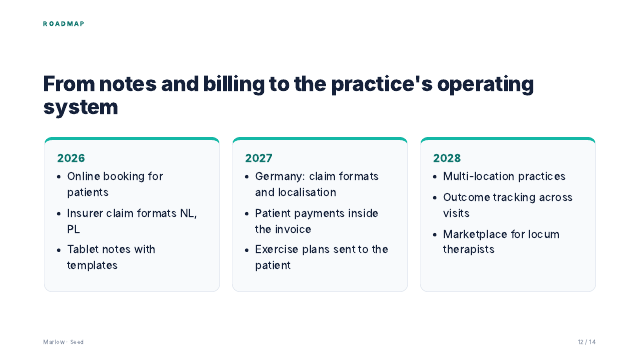
Slides 3, 12low effortActionCite the specific regulation or national body behind the 2027 digital-records claim on slide 3 and attach a measurable target to each roadmap year on slide 12, marking what is deferred for a three-person team.
Why it mattersThe timing argument is strong but uncited, and the 2028 roadmap (outcome tracking, payments, exercise plans, locum marketplace) is too broad to be credible.
DeliverableNamed-regulation line per driver on slide 3; roadmap rows with ARR/practice targets and a 'deferred' marker on slide 12.
Expected impactStrengthens Regulatory & Compliance (66/100) and focus perception.
Top Strengths
i- Founder-market fit is credible and specific: CEO Anna K. is a practising physiotherapist with eight years in a four-therapist Utrecht practice who ran the admin herself (the origin of the product), paired with a CTO who previously led a payments team at a Polish fintech and a product designer from a two-million-user consumer app - plus advisors including a former NL insurer claims director and an exited DE healthcare software founder.
- Problem is grounded in primary research rather than assertion: 38 practice interviews in 2025 yield concrete, quantified pain (6 hours/week of admin per therapist in a two-person practice; 23-day average gap between visit and invoice), and the solution maps one-to-one onto that pain - book, treat, note, bill on one screen, with a credible customer quote from a Utrecht practice owner.
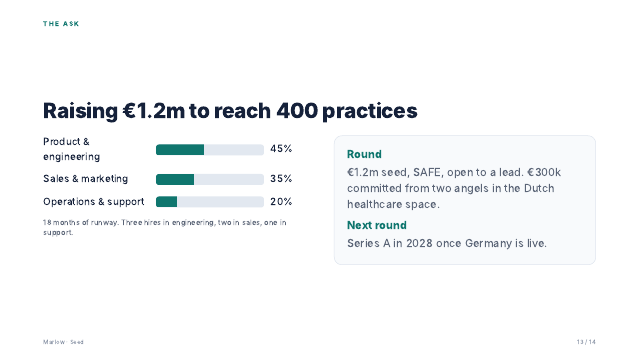
- The ask is clean and well-structured: €1.2m SAFE, 18 months runway, a clear allocation (45% product/engineering, 35% sales/marketing, 20% ops/support), named hiring plan (3 engineering, 2 sales, 1 support), €300k already committed from two Dutch healthcare angels, and a defined Series A trigger (Germany live, 2028) - with a sensible NL/PL-first expansion order tied to founder networks.
Priority Fixes
i- 1Replace the logo wall on slide 7 with a metrics slide: current MRR/ARR, how many of the 11 practices are paying vs in trial, trial-to-paid conversion rate, logo churn since March 2026, and a monthly cohort chart. Keep the six named references as a secondary strip, not the headline.
- 2Add a competitive landscape slide naming actual incumbents in the Netherlands, Germany and Poland plus horizontal alternatives (paper, calendar apps, spreadsheets), with an explicit defensibility thesis - built-in insurer claim formats, tablet-native notes workflow, and self-serve setup speed - and state what makes it hard to copy.
- 3Rebuild slide 9 bottom-up: show practices × €89/month (plus €19/therapist uplift) by year to reach €18m ARR, label the y-axis, and reconcile the implied ~17,000 practices against the bottom-up count of physiotherapy practices in NL, PL and DE. Replace the €4.2bn top-down TAM on slide 4 with SAM/SOM derived from that same practice count.
- 4Add a unit-economics panel to the GTM slide: CAC per channel (outbound, referral, association), payback months against ~€1,068 ACV, LTV/CAC, and a gross-margin build that explicitly carries bundled SMS, tri-country claim-format maintenance and support cost - the current 80% margin claim will not survive diligence otherwise.
- 5Add a compliance and switching-cost slide: GDPR data residency and processor arrangements for patient notes across three jurisdictions, cite the specific regulation or national body behind the 2027 digital-records claim on slide 3, and show evidence from the 11 live practices on how handwritten record migration is handled and how long onboarding actually takes. Separately, tighten the 2028 roadmap - outcome tracking, patient payments, exercise plans and a locum marketplace is too broad for a three-person team; state the sequencing and what is deferred.
Investor Readiness
iBlockers
- 1No competitive landscape slide - incumbents in physio practice software (e.g. regional PMS vendors) are unaddressed, and no moat or defensibility argument is made
- 2Traction is qualitative: 11 practices and logos shown, but no MRR/ARR, retention, churn, conversion or growth trend data
- 3Market sizing is top-down only (€4.2bn TAM from an industry report) with no SAM/SOM or bottom-up practice-count × ARPU calculation
- 4No unit economics - CAC, payback or LTV/CAC absent despite a stated direct-sales motion
Improvements for Next Level
- →Add a traction slide with ARR, MoM growth, trial-to-paid conversion and logo retention across the 11 live practices
- →Add a competitive slide naming incumbents and the specific wedge (insurer formats, tablet notes, afternoon setup) plus switching-cost/data moat
- →Rebuild market sizing bottom-up: number of 1-4 therapist practices per target country × €1,068 annual ACV, with a defined beachhead SOM
- →Show CAC per practice from the outbound/demo motion and payback period to validate the €89/month price point
- →Tie the €1.2m ask to explicit milestones (e.g. practices, ARR and Germany go-live) that justify the 2028 Series A
Fundraising Readiness Roadmap
Almost Ready for Seed roundNo competitive landscape slide - incumbents in physio practice software (e.g. regional PMS vendors) are unaddressed, and no moat or defensibility argument is made
Traction is qualitative: 11 practices and logos shown, but no MRR/ARR, retention, churn, conversion or growth trend data
Market sizing is top-down only (€4.2bn TAM from an industry report) with no SAM/SOM or bottom-up practice-count × ARPU calculation
Rebuild Slide 7 as a metrics slide: paying practices by month, MRR trend, and MoM growth rate since March 2026
Add a dedicated competition slide naming real alternatives (e.g. incumbent EU physio/practice suites, generic scheduling apps, paper + spreadsheet) and score each on setup time, tablet notes, and insurer claim coverage
Rebuild the model bottom-up: practices added per month per sales rep x €89 ARPU x retention, and show the implied practice count beside each ARR year
What Would Change an Investor's Mind
Radar Analysis
iCONTENT / NARRATIVE - SCORE 71 (Grade B)
Internal reference profile overlay
VISUAL ANALYSIS - SCORE 79 (Grade B+)
Internal reference profile overlay
Content & Narrative
i10-dimension analysis
Problem Statement
82The problem is specific, quantified and validated with primary research - 6h/week of admin per therapist and a 23-day visit-to-invoice gap drawn from 38 practice interviews.
- Slide 2: 6h/week of admin per therapist in a two-person practice, sourced to own interviews with 38 practices, 2025
- Slide 2: 23 days average gap between a visit and the invoice - a quantified cash-flow pain
- Slide 2: Clear persona and failure chain - notes handwritten after hours, double bookings from separate calendars, insurer forms re-typed a third time
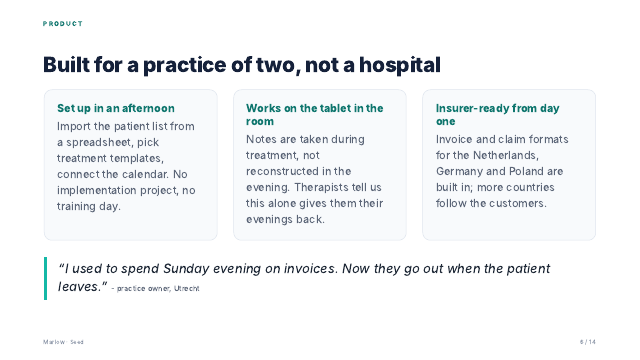
- Slide 6: Practice owner in Utrecht quote - "I used to spend Sunday evening on invoices" - evidences pain intensity
- Slide 2: Pain is never converted to money - no euro value of 6h/week or cost of the 23-day invoice lag on practice cash flow
- Slide 2: No direct customer quote on the problem slide itself; the only quote appears two slides later
- Slide 2: No evidence of current spend or willingness to pay (what practices pay today for calendar/spreadsheet workarounds)
- Add a euro conversion on Slide 2: '6h/week x €45/h therapist rate = ~€12k/year of lost billable capacity per practice'
- Move or duplicate the Utrecht owner quote onto Slide 2 and add a second quote about double bookings or insurer re-typing
- State what the 38 interviewed practices currently spend on software/admin today to show willingness to pay
Solution & Value Proposition
80A one-sentence UVP ('one screen for the whole visit: book, treat, note, bill') backed by a real product UI mock and 11 live practices since March 2026.
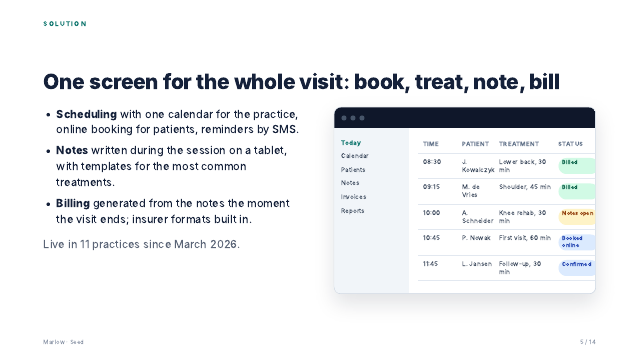
- Slide 5: UVP in one line - 'One screen for the whole visit: book, treat, note, bill' - with a detailed product UI mock (Today/Calendar/Patients/Notes/Invoices, colour-coded Billed / Notes open / Booked online statuses)
- Slide 5: Live in 11 practices since March 2026 - working product with real users
- Slide 6: Non-obvious insight - insurer claim formats for NL, DE and PL built in from day one, plus 'setup in an afternoon, no implementation project'
- Slide 6: Outcome quote - invoices 'go out when the patient leaves' instead of Sunday evening
- Slide 6: No quantified after-state - the 23-day gap and 6h/week from Slide 2 are never restated as improved numbers for the 11 live practices
- Slide 5: Visual is a mock UI, not a screenshot or demo of the shipped product in a real practice
- Slide 6: Differentiators (setup speed, tablet notes) risk reading as 'better UX' without a named incumbent to contrast against
- Add a before/after bar on Slide 6: 'visit-to-invoice 23 days to 2 days; admin 6h/week to 1.5h/week across 11 live practices'
- Replace the mock with a real screenshot or add a 20-second demo QR link for diligence
- Name the tools being replaced (paper + generic calendar app + spreadsheet, or a specific legacy desktop vendor) and show the switching cost removed
Market Opportunity
64A single €4.2bn top-down TAM from an unnamed 'industry report' with no SAM or SOM, partially rescued by a genuinely strong three-point 'why now'.
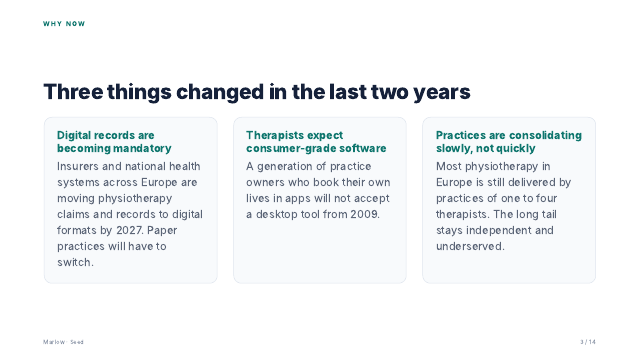
- Slide 3: Specific dated catalyst - insurers and national health systems moving physiotherapy claims and records to digital formats by 2027, forcing paper practices to switch
- Slide 3: Generational tailwind (owners who book their own lives in apps reject 2009 desktop tools) plus a fragmented, slowly consolidating long tail of 1-4 therapist practices
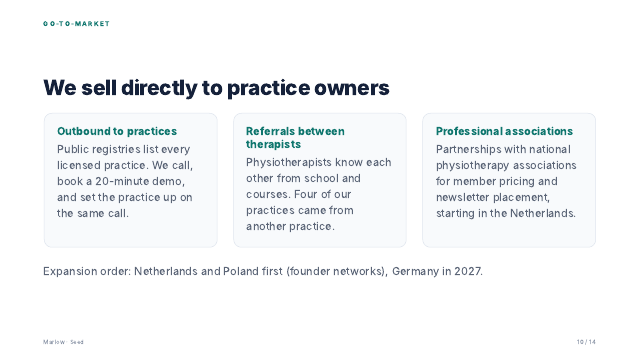
- Slide 10: Realistic beachhead defined - Netherlands and Poland first via founder networks, Germany in 2027
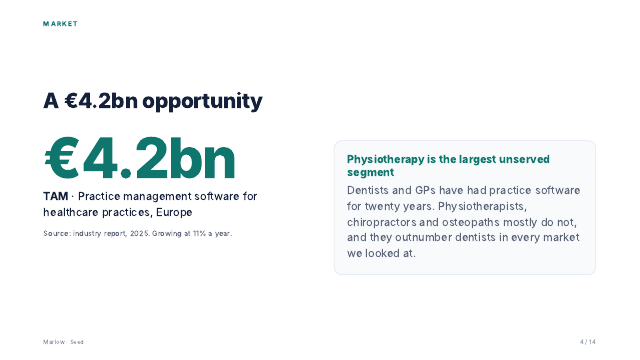
- Slide 4: Segment logic that physios/chiros/osteopaths outnumber dentists in every market looked at, and lack software dentists have had for 20 years
- Slide 4: TAM is top-down only - '€4.2bn, source: industry report, 2025' with no report named and no methodology
- Slide 4: No SAM or SOM anywhere in the deck despite a clear price point and countable practice universe
- Slide 4: TAM is scoped to all European healthcare practice management software, not physiotherapy - it overstates the addressable segment the deck actually targets
- Slide 4: The claim that physios outnumber dentists 'in every market we looked at' is unsourced and uncounted
- Replace the top-down number with a bottom-up build: 'X licensed physio practices in NL/PL/DE from public registries x €89-€146/month ARPU = €Ym SAM'
- Add a SOM line tied to the ask: '400 practices by 2028 = €0.6m ARR, 0.9% of the NL+PL beachhead'
- Name the source report and date, and split TAM into physiotherapy-specific vs adjacent allied-health segments
- Cite the specific 2027 insurer/national mandate by name on Slide 3 to make the catalyst verifiable
Business Model
72Pricing is clear, concrete and well-structured (€89/practice/month, €19 per extra therapist, annual at 2 months free) with an 80% gross margin claim, but there are no CAC, LTV or payback figures.
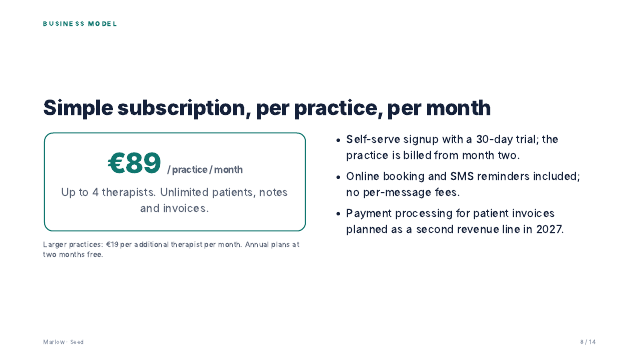
- Slide 8: Concrete pricing - €89/practice/month up to 4 therapists, €19 per additional therapist, annual plans at two months free
- Slide 8: Low-friction motion - self-serve signup, 30-day trial, billed from month two, SMS reminders included with no per-message fees
- Slide 8: Clear second revenue line - patient invoice payment processing planned for 2027, echoed on the Slide 12 roadmap
- Slide 9: 80% gross margin at scale assumption stated explicitly
- Slide 9: No CAC, LTV or payback period anywhere - critical given the Slide 10 outbound call-and-demo sales motion
- Slide 8: €89 price is not justified - no reference to competitor pricing or to what practices spend on admin today
- Slide 9: No churn or retention assumption behind the 40% YoY growth and €18m ARR path
- Slide 8: Bundling SMS with 'no per-message fees' carries a variable cost that is unmodelled against the 80% margin claim
- Add a unit-economics strip to Slide 8: 'CAC €X from outbound (Y demos per close), ARPU €1,068/yr, payback Z months, LTV/CAC N:1'
- Justify €89 by anchoring it: 'vs €12k/yr of therapist time recovered' or 'vs €X charged by the nearest incumbent'
- State observed logo churn or renewal rate from the 11 live practices, even if the sample is small
- Model SMS cost per practice per month explicitly to defend the 80% gross margin
Traction & Metrics
5811 live practices since March 2026 and 6 named partners are real signals, but the deck shows no revenue, no MoM growth, no retention - the traction slide is a logo wall, not metrics.
- Slide 5: Live in 11 practices since March 2026 - a working, deployed product, not a pilot concept
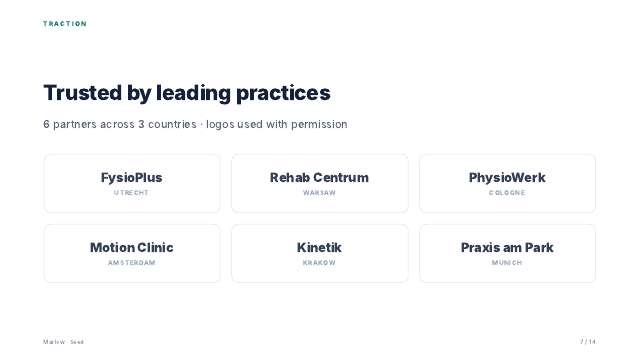
- Slide 7: 6 named partner practices across 3 countries (NL, PL, DE), logos used with permission
- Slide 10: Four practices came via referral from another practice - early organic word-of-mouth signal
- Slide 9: 2026 revenue line of €0.1m implies some paying customers exist
- Slide 7: Logo wall with zero metrics - no MRR, no seats, no usage, no retention, and no growth trend of any kind
- Slide 7: Count inconsistency - 6 partners shown here vs 11 live practices claimed on Slide 5, with no reconciliation of how many are paying
- Slide 7: Partner cards are text-only, not actual logos, weakening the 'trusted by leading practices' claim
- Slide 9: Jumps from no current metrics straight to a €18m ARR projection with 40% YoY growth and no y-axis scale - projection substitutes for evidence
- Slide 9: No cohort retention, churn or engagement data despite the product being live since March 2026
- Rebuild Slide 7 as a metrics slide: paying practices by month, MRR trend, and MoM growth rate since March 2026
- Reconcile 6 vs 11 explicitly: 'X paying, Y in trial, Z pilots' with the trial-to-paid conversion rate
- Add engagement proof of product-market fit: % of visits noted in-app, % of invoices generated from notes, weekly active therapists
- Promote the referral stat to the traction slide - '4 of 11 practices came from referral, zero paid acquisition' is a strong PMF signal
- Show a retention line: logo retention since March 2026 and any expansion from the €19 per-extra-therapist upsell
Competitive Landscape
42There is no competition slide at all; the only competitive reference is an indirect remark that dentists and GPs have had practice software for twenty years while physios mostly do not.
- Slide 6: Insurer-ready claim formats for the Netherlands, Germany and Poland are built in - a potential regulatory/integration barrier
- Slide 3: 'Therapists expect consumer-grade software' positions against legacy desktop tools from 2009
- Slide 4: Argues physiotherapists outnumber dentists in every market examined, implying an underserved niche versus established dental/GP software
- Slide 4: Claims physiotherapy is 'the largest unserved segment' with no named competitor to test the claim
- Deck-wide: No competition slide exists in the 14-slide flow (Slides 1-14) - no matrix, no feature comparison, no alternatives list
- Slide 8: €89/practice/month pricing is presented with no competitive price benchmark
- Slide 6: Product differentiation ('setup in an afternoon') is asserted but never contrasted against a specific rival onboarding experience
- Deck-wide: No moat argument - no data network effect, switching cost or IP claim is articulated
- Add a dedicated competition slide naming real alternatives (e.g. incumbent EU physio/practice suites, generic scheduling apps, paper + spreadsheet) and score each on setup time, tablet notes, and insurer claim coverage
- Reframe insurer claim formats for NL/DE/PL as an explicit moat: state how many months of regulatory work each country took and why it deters generic schedulers
- Name the status-quo alternative honestly - 'our biggest competitor is a calendar app plus Excel' - and show win/loss evidence from the 11 live practices
- Quantify switching costs: patient-record migration, invoice history, and association partnerships that make churn unlikely
Team & Founders
78Three complementary founders with a physiotherapist CEO, a technical CTO and a consumer product designer, plus two relevant advisors - but surnames, logos and verifiable credentials are missing.
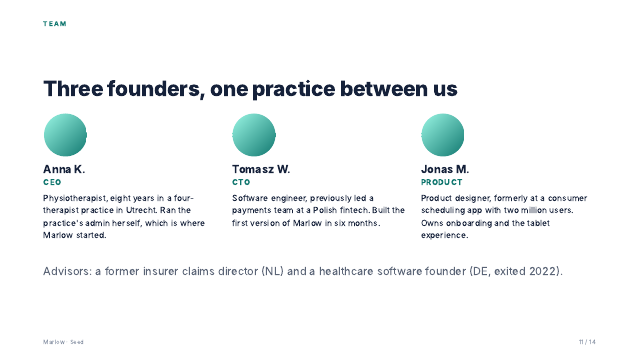
- Slide 11: Anna K., CEO, physiotherapist with eight years in a four-therapist Utrecht practice who ran the practice admin herself - direct domain and problem ownership
- Slide 11: Tomasz W., CTO, software engineer who previously led a payments team at a Polish fintech and built the first version of Marlow in six months
- Slide 11: Jonas M., Product, designer formerly at a consumer app with two million users, owning onboarding and the tablet experience
- Slide 11: Advisors include a former insurer claims director (NL) and a healthcare software founder (DE) who exited in 2022
- Slide 10: Expansion order explicitly leverages founder networks in the Netherlands and Poland, matching the founders' stated geographies
- Slide 11: Founders listed with initials only (Anna K., Tomasz W., Jonas M.) - no full names, LinkedIn or verifiable employer names
- Slide 11: Founder images are placeholder teal gradient circles rather than photographs, weakening credibility
- Slide 11: No prior startup founding or exit experience among the three founders; the only exit sits with an advisor
- Slide 13: Six hires planned (three engineering, two sales, one support) but no named key hires or leadership gaps identified
- Slide 11: No commercial/sales leadership identified despite an outbound-heavy go-to-market on Slide 10
- Use full surnames plus real headshots and name the prior employers (the Polish fintech, the two-million-user consumer app) to make credentials checkable
- Add equity/commitment detail: full-time status and founding date for each of the three founders
- State who owns sales today and whether the two planned sales hires report to the CEO, given direct outbound is the primary channel
- Name the advisors (or at least their former institutions) to make the insurer claims director and exited DE healthcare founder verifiable
Financial Projections
63A five-year ARR curve from €0.1m (2026) to €18m (2030) with two stated assumptions, but no bottom-up build from the €89/month price point and an inconsistent growth rate.
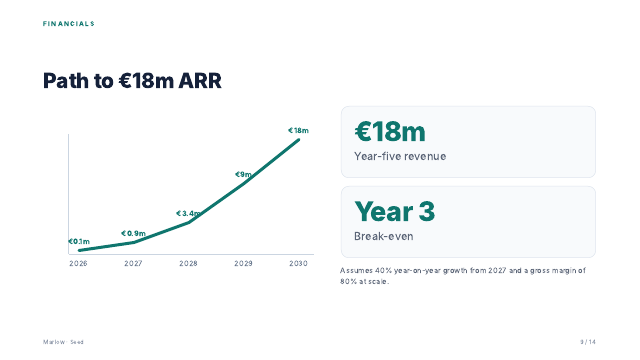
- Slide 9: Five-year ARR path shown with explicit values - €0.1m 2026, €0.9m 2027, €3.4m 2028, €9m 2029, €18m 2030
- Slide 9: Break-even explicitly flagged in Year 3, giving a stated path to profitability
- Slide 9: Two assumptions disclosed - year-on-year growth rate and 80% gross margin at scale
- Slide 8: Clear revenue mechanics (€89/practice/month, €19 per extra therapist, annual plans at two months free) that could support a bottom-up build
- Slide 9: The stated '40% year-on-year growth from 2027' contradicts the plotted curve (€0.9m to €3.4m is ~280% growth)
- Slide 9: Chart has no y-axis scale or gridlines, and the exponential shape reads as a hockey stick
- Slide 9: No practice-count bridge - €18m ARR is never converted into customers at the €89 price point
- Slide 13: No burn rate, monthly cost base or headcount cost given despite an 18-month runway claim
- Slide 8: Payment processing as a 2027 second revenue line is not modelled or sized in the financials
- Rebuild the model bottom-up: practices added per month per sales rep x €89 ARPU x retention, and show the implied practice count beside each ARR year
- Fix the assumption text so the stated growth rate matches the plotted curve, or restate as 'tripling to 2028 then 40% thereafter'
- Add a cost line and net burn to the chart so the Year 3 break-even claim is visibly supported
- Publish early unit economics from the 11 live practices - CAC from the 20-minute demo motion, trial-to-paid conversion, and monthly churn
- Model the 2027 payments line separately with take-rate assumptions, or exclude it and note it as upside
Ask & Use of Funds
83A specific €1.2m SAFE with a three-way percentage allocation, 18 months of runway, named hires, a target milestone of 400 practices and €300k already committed.
- Slide 13: Specific ask of €1.2m seed on a SAFE, open to a lead, with a clear practice-count milestone of 400 practices
- Slide 13: Allocation stated as Product & engineering 45%, Sales & marketing 35%, Operations & support 20%
- Slide 13: 18 months of runway with six named hires - three engineering, two sales, one support
- Slide 13: €300k already committed from two Dutch healthcare angels, showing early validation of the round
- Slide 13: Next round framed as Series A in 2028 once Germany is live, linking the raise to the roadmap on Slide 12
- Slide 13: Percentages are shown without € amounts, so the reader must do the arithmetic on the bar chart
- Slide 13: No SAFE cap, discount or target valuation disclosed
- Slide 13: The 400-practice milestone is not reconciled with the 2027 ARR of €0.9m on Slide 9 (400 practices at €89/month is roughly €0.4m)
- Slide 13: No prior funding history or capital efficiency evidence from building the first version
- Slide 12: Roadmap milestones (Germany localisation, patient payments) are not explicitly costed against the 18-month runway
- Add € figures alongside percentages (e.g. €540k product, €420k sales, €240k operations) and state monthly burn
- Disclose the SAFE valuation cap and discount so investors can price the round
- Reconcile the 400-practice milestone with the 2027 ARR figure on Slide 9, or restate the milestone in ARR terms
- Add a short 'what €1.2m buys' line: specific Series A readiness metrics such as ARR, net revenue retention and Germany go-live date
Storytelling & Design
76A tight 14-slide arc from paper-age problem to a memorable closing line, with consistent teal branding, a credible product mock and quantified callouts - undermined by placeholder logos and headshots.
- Slide 2: Problem opens with quantified pain - 6h/week of admin per therapist and a 23-day average gap between visit and invoice, sourced to 38 practice interviews
- Slide 5: Clean product UI mock with colour-coded status pills (Billed, Notes open, Booked online, Confirmed) makes the workflow instantly legible
- Slide 6: A customer quote from a practice owner in Utrecht ('I used to spend Sunday evening on invoices') adds a human voice
- Slide 14: Strong closing line 'Every practice, out of the paper age' with contact details - a clear CTA
- Deck-wide: Consistent teal branding and 'Marlow · Seed X/14' footers across all 14 slides, the ideal deck length
- Slide 7: 'Trusted by leading practices' is illustrated with text-only cards and no actual logos, despite claiming logos are used with permission
- Slide 11: Founder photos are placeholder teal gradient circles rather than real headshots
- Slide 9: The ARR chart has no y-axis scale or gridlines, weakening the data visualisation
- Slide 2: Problem slide text is dense and the stat callouts (6h/week, 23 days) are visually interleaved with body copy, making the layout hard to scan
- Deck-wide: No competition slide breaks the expected investor narrative between traction and business model
- Replace the Slide 7 text cards with the actual practice logos, or reframe it as '11 practices live since March 2026' with a usage metric instead of a logo wall
- Swap placeholder circles on Slide 11 for real headshots and add company logos for prior employers
- Restructure Slide 2 so the two hero stats (6h/week, 23 days) sit as large standalone figures with the supporting bullets beneath
- Add gridlines and a labelled y-axis to the Slide 9 ARR chart, and insert a competition slide between Slides 7 and 8
Regulatory & Compliance
66The deck shows implicit regulatory awareness - insurer claim formats for NL/DE/PL and a 2027 digital-records mandate - plus a former insurer claims director as advisor, but there is no mention of GDPR, EU MDR, or health-data hosting, and no compliance owner, timeline or cost.
- Slide 3: "Insurers and national health systems across Europe are moving physiotherapy claims and records to digital formats by 2027" - regulatory driver named as a why-now
- Slide 6: "Invoice and claim formats for the Netherlands, Germany and Poland are built in" - jurisdiction-specific compliance work already shipped
- Slide 11: Advisor is a "former insurer claims director (NL)" - partial regulated-domain expertise on the bench
- Slide 10: go-to-market uses "public registries list every licensed practice" and national association partnerships, implying familiarity with the licensing landscape
- Slide 5/6: Patient notes and patient lists are handled across NL/PL/DE with no mention of GDPR, special-category health data, consent, or data residency
- Slide 12: "Outcome tracking across visits" and exercise plans sent to patients raise a potential EU MDR classification question that is never addressed
- Slide 13: Use of funds (45% product, 35% sales, 20% ops) allocates no budget line to compliance, certification or legal
- Slide 11: No compliance officer or DPO named across the three founders or the two advisors
- Slide 12: Roadmap milestones are feature-based only - no certification or audit milestones (e.g. ISO 27001, NEN 7510) with dates
- Add a compliance slide stating: "GDPR Art. 9 special-category data; EU-hosted (Frankfurt/Amsterdam), DPAs with all practices, DPO appointed Q3 2026"
- State explicitly why Marlow is not a medical device under EU MDR (administrative record-keeping, no diagnostic or therapeutic claim) - or name the class and pathway if it is
- Name the per-country claim standards you support (e.g. Dutch Vektis/VECOZO claim formats, German KBV/Heilmittel billing rules, Polish NFZ) to convert "built in" into verifiable compliance work
- Add an ISO 27001 / NEN 7510 certification timeline with cost estimate to the roadmap and a corresponding line item in the use-of-funds chart
- Elevate the former insurer claims director advisor into a named compliance owner with a defined engagement (e.g. monthly claims-format review)
IP & Technical Defensibility
51No patents, no proprietary dataset, and no technical moat argument - defensibility rests entirely on vertical focus and the labour of building insurer claim formats for three countries, which is workflow integration rather than hard tech.
- Slide 6: "Invoice and claim formats for the Netherlands, Germany and Poland are built in" - multi-jurisdiction integration depth is the de facto moat
- Slide 5: Product is live in 11 practices since March 2026, indicating a working, shipped system rather than a concept
- Slide 12: "Outcome tracking across visits" on the 2028 roadmap is a plausible future proprietary dataset
- Slide 11: CTO Tomasz W. previously led a payments team at a Polish fintech, relevant to the planned 2027 patient-payments line
- Slide 1-14: No patent filings, trade secrets, or IP strategy mentioned anywhere in the deck
- Slide 11: "Built the first version of Marlow in six months" implicitly signals low technical barrier to replication
- Slide 6: Setup "in an afternoon" and spreadsheet import describe ease of onboarding - which also means low switching cost away from Marlow
- Slide 5/8: No data flywheel, network effect, or contract lock-in argument; €89/month self-serve with a 30-day trial is easy to churn
- Slide 7: Six named partners across three countries, but no retention, churn or NPS figure to evidence stickiness as a substitute moat
- Add a defensibility line quantifying the integration moat: e.g. "X insurer claim formats, Y months of regulatory mapping per country - the barrier competitors must clear per market"
- Replace the 'built in six months' framing with the hard part: multi-country claim validation logic, tablet-first offline note capture, or billing-from-notes automation
- State switching costs explicitly: once a practice's full patient history and invoices live in Marlow, migration is painful - back it with logo retention since March 2026
- Articulate the outcome-tracking data flywheel (anonymised treatment-outcome benchmarks across thousands of visits) as a 2028 asset insurers would pay for
- Mention any IP posture at all - even "no patents filed; moat is regulatory integration depth plus trademark" is better than silence, and consider a freedom-to-operate note on claim-format interfaces
Visual & Design
i7-dimension visual pass
Visual Hierarchy
82A disciplined system of small teal eyebrow labels, large navy headlines and oversized teal stat numbers guides the eye reliably; the €4.2bn and 6h/week figures dominate correctly. Weakness is that several slides end hierarchy at the headline, with all body copy rendered at one uniform weight.
- Slide 4: the giant teal '€4.2bn' is the clear focal point before the supporting TAM caption
- Slide 2: stat cards '6h / week' and '23 days' pull attention right while bullets sit left
- Consistent uppercase letter-spaced section tags (PROBLEM, MARKET, TEAM) orient the viewer instantly
- Slides 3, 6, 10, 12: three equal-weight cards create a flat read with no 'most important' point
- Slide 5: the key traction line 'Live in 11 practices since March 2026' is grey and visually de-emphasised despite being the strongest proof point
- Slide 13: allocation bars and the round box compete - neither is clearly primary
- Promote 'Live in 11 practices since March 2026' on slide 5 to a teal stat chip at top-right of the mock
- On three-card slides, emphasise one card with a teal fill or heavier border to signal the lead argument
- Add a one-line bolded takeaway under each headline (e.g. 'Admin, not treatment, is the bottleneck') to anchor the eye
Readability
74High contrast navy-on-white with generous line spacing makes body text comfortable on screen, but card body copy is noticeably small (roughly 11-12px equivalent) and would dissolve at 3 metres.
- Slide 2 headline and slide 9 '€18m' are legible from across a room
- Clean grotesk typeface with no italics or condensed text; excellent white background contrast
- Slide 11 team bios are set in small grey text that is hard to read projected
- Slide 5 schedule table uses very small type for TIME/PATIENT/TREATMENT rows
- Footnotes on slides 4, 8, 9, 13 are light grey and borderline sub-legible
- Raise all card/bio body copy by 2-3pt and darken grey from ~#8A94A6 to ~#4A5568
- Enlarge the slide 5 product mock by 15% or crop to 4 rows so the table text is readable
- Cap bullets at 12 words - e.g. slide 2's four bullets can become three tighter lines
Layout
83A consistent 12-column feel with wide left margins, generous whitespace and a repeated 3-card grid gives the deck a clean, modern SaaS look; the main flaw is unbalanced bottom whitespace on several slides.
- Slides 3, 6, 7, 10, 12 use an evenly gutter-spaced three-card grid with equal card heights
- Slide 2's two-column split (bullets left, stat cards right) is well balanced
- Consistent footer rule: 'Marlow · Seed' left, page number right on every slide
- Slides 4, 8, 10, 13 leave a large empty lower-third, making content feel top-heavy
- Slide 5's product mock is clipped at the right edge of the card, cutting the STATUS column
- Slide 13's bar chart labels and bars occupy only the left third, leaving a thin, cramped visual
- Vertically centre content on sparse slides (4, 8, 10) or add a supporting proof strip in the empty band
- Reframe the slide 5 UI mock with equal padding so no column is cropped
- Widen slide 13's allocation bars to full column width and add € amounts next to each percentage
Consistency
91Exceptionally disciplined: one typeface, one navy (#131A2B-ish), one teal accent (#0E7C66/#2EC4A6), and the same rounded light-grey card component reused throughout - it reads as a single designed system, not assembled slides.
- Identical eyebrow label style and footer treatment on slides 2-13
- Same #F5F7FA card with 8px radius used on slides 2, 3, 4, 6, 7, 9, 10, 12, 13
- Cover (slide 1) teal gradient and closing (slide 14) navy bookend each other with the same marlow lockup
- Slide 12 cards have a teal top border while slides 3/6/10 cards do not - an unexplained variant
- Slide 8 pricing box uses a teal outline while all other cards are fill-only
- Card internal padding varies slightly between slides 6 and 12
- Codify two card variants only: 'neutral' and 'highlight' (teal top border), and apply by meaning
- Standardise card padding to 24px and heading-to-body spacing to 8px across all grid slides
- Match the slide 8 price box style to the slide 9 stat card for a unified stat treatment
Data Visualization
66There are only two true charts - a smooth teal revenue curve (slide 9) and horizontal allocation bars (slide 13) - both clean but minimal; most quantitative content lives in text or stat cards instead of visuals.
- Slide 9 line chart labels every data point (€0.1m, €0.9m, €3.4m, €9m, €18m) with a clear 2026-2030 axis
- Slide 13 bars are cleanly aligned with right-side percentage labels (45/35/20%)
- Slide 2 uses oversized teal numerals as a lightweight stat-card substitute for charts
- Slide 9 has no y-axis values or gridlines, so the curve reads as a generic hockey stick rather than evidenced projection
- No traction chart anywhere - 11 practices and 6 partners appear only as text/logos, with no growth-over-time visual
- Slide 4 shows a single TAM number with no TAM/SAM/SOM breakdown or visual
- Add a traction chart (practices or MRR by month since March 2026) - the deck's biggest visual gap
- Add a light y-axis with €m gridlines and plot actuals vs. forecast in different line styles on slide 9
- Convert slide 4 into a nested TAM/SAM/SOM graphic showing the physiotherapy slice of the €4.2bn
Credibility Signals
64The logo wall is text-only placeholder boxes and team photos are plain teal gradient circles, which undercuts an otherwise professional aesthetic; the customer quote and named cities help.
- Slide 7 names six practices with cities (Utrecht, Warsaw, Cologne, Amsterdam, Krakow, Munich) and states 'logos used with permission'
- Slide 6 includes a pull-quote with teal left rule attributed to a practice owner in Utrecht
- Slide 5 includes a realistic product UI mock with browser chrome, which signals a shipped product
- Slide 7 cards contain typeset names, not actual logos - looks like an unfinished placeholder
- Slide 11 founders are represented by abstract teal spheres instead of headshots; surnames are abbreviated (Anna K., Tomasz W., Jonas M.)
- No press, association, or insurer logos despite claims about associations and insurer formats
- Replace slide 7 text boxes with real greyscale logos; if unavailable, show a map of 3 countries with pin counts instead
- Use real founder headshots and full names plus prior company logos (Polish fintech, consumer scheduling app)
- Add advisor names/affiliations and a retention or NPS stat beside the logo wall to strengthen proof
Narrative Flow
85Classic, well-sequenced seed arc - hook, problem, why now, market, solution, product, traction, model, financials, GTM, team, roadmap, ask, closing - with a strong navy closing slide and clear CTA line.
- Slide 3 'Why now' placed before market sizing builds urgency early
- Slide 14 closing is a bold navy statement slide with email and location - a clean CTA bookend
- Section eyebrow labels act as chapter markers so the viewer always knows where they are
- Traction (slide 7) arrives late and is thin - a logo wall with no revenue or growth metric after a 5-slide setup
- Slide 4's market slide sits before the solution, delaying the product reveal past the midpoint
- No competition/moat slide anywhere, a visible gap in the arc for investors
- Move a hard traction metric (11 practices, MRR, retention) into the cover or slide 2 as an early credibility hook
- Insert a competitive landscape slide between slides 6 and 7 using the existing card grid
- End slide 13 with a single bold line ('€1.2m → 400 practices by 2028') to hand off cleanly into the closing slide
Missing Content
i9 itemsKnow Your Business
KYBi- Slide 8: Pricing is concrete and legible - €89/practice/month for up to 4 therapists, €19 per additional therapist, 30-day trial with billing from month two, and annual plans at two months free, showing the founder has thought through packaging rather than hand-waving 'SaaS'.
- Slide 8 & 12: A second revenue line (patient payments in 2027) is explicitly sequenced into the roadmap alongside insurer claim formats and a locum marketplace, suggesting an understanding of ARPU expansion beyond a thin €89 seat price.
- Slide 6: The product thesis - 'setup in an afternoon', spreadsheet import, no implementation project, no training day - reflects a correct read that low-touch onboarding is the only viable model at this price point.
- Slide 13: Use of funds is split 45% product / 35% sales / 20% ops with 18 months runway, six named hires, and €300k already committed on a SAFE, indicating basic capital-plan discipline.
- Slide 9: The €18m ARR by 2030 curve rests on 40% YoY growth and an 80% gross margin assumption with no y-axis, no practice count, no ARPU bridge - at €89/month that implies roughly 17,000 practices, a number never reconciled anywhere in the deck.
- Slide 10 & 13: A direct outbound sales motion with 20-minute demos is proposed but CAC, payback period and LTV/CAC are entirely absent, which is fatal arithmetic when annual contract value is €1,068.
- Slide 7: Traction is logo-wall only - 11 practices since March 2026 with zero MRR, churn, trial-to-paid conversion or expansion data, so the real unit of progress is unverifiable.
- Slide 8: The 80% gross margin claim ignores embedded costs of SMS reminders with no per-message fees, insurer claim-format maintenance across three countries, and support for non-technical practice owners.
Know Your Customer
KYCi- Slide 2: Pain is quantified from primary research - 6h/week of admin per therapist and a 23-day average gap between visit and invoice, sourced from 38 practice interviews in 2025, which is far above typical seed-stage customer evidence.
- Slide 11: The CEO is a practicing physiotherapist with eight years in a four-therapist practice who ran the admin herself - genuine founder-market fit rather than an outsider's thesis.
- Slide 6: The Utrecht owner quote - 'I used to spend Sunday evening on invoices' - captures the actual emotional job-to-be-done (evenings back), not a feature list.
- Slide 10: Customer behaviour insight that four of the practices came from another practice shows awareness of therapist-to-therapist referral dynamics as a real acquisition channel.
- Slide 2: The interviews establish pain but never willingness to pay - no evidence a practice that tolerated paper for 20 years will convert at €89/month, nor any price-sensitivity testing against free calendar apps.
- Slide 5: The patient is a silent stakeholder - online booking and SMS reminders are sold to the owner, but patient adoption rates, no-show reduction or data-consent friction are never measured.
- Slide 7: Six named reference practices are shown but no cohort view - how many of the 11 live practices are paying, how many came off the 30-day trial, and whether any have churned is unanswered.
- Slide 10: The buyer and the user are often the same overworked owner, yet there is no account of the switching cost - migrating years of handwritten patient records is the single biggest objection and it is unaddressed.
Know Your Environment
KYEi- Slide 3: The Why Now thesis is coherent - digital claims/records mandates by 2027, generational rejection of 2009-era desktop tools, and a fragmented long tail of 1-4 therapist practices that incumbents ignore.
- Slide 4: Correct structural observation that dentists and GPs have had practice software for twenty years while physios, chiropractors and osteopaths have not, and that physios outnumber dentists in every market examined.
- Slide 11: An advisor who is a former insurer claims director (NL) plus a German healthcare software founder (exited 2022) gives credible access to the regulatory and claims environment.
- Slide 10 & 12: Expansion is sequenced by founder networks (NL, PL first, Germany 2027) with national association partnerships for member pricing - a realistic read of how fragmented healthcare markets are entered.
- Slide 7: There is no competitive slide at all - entrenched regional PMS vendors in NL, DE and PL, plus horizontal players, are never named, and no moat or defensibility argument exists beyond UX.
- Slide 3: The 2027 digital mandate is asserted without citing which regulation, insurer or national body imposes it - if the deadline slips, the entire Why Now collapses.
- Slide 6: GDPR and national health-data rules are invisible despite storing patient treatment notes across three jurisdictions - no mention of data residency, processor agreements or medical-device/record certification burdens.
- Slide 8 & 12: The 2027 payments line implies PSD2 / payment-institution licensing or a PSP dependency, yet the regulatory and take-rate economics of that pivot are entirely unexamined.
Reference Profile Comparison
How your deck compares to internal investor-readiness reference profiles
Competitive Landscape
iCompetitive Landscape
42/100There is no competition slide at all; the only competitive reference is an indirect remark that dentists and GPs have had practice software for twenty years while physios mostly do not.
- Slide 6: Insurer-ready claim formats for the Netherlands, Germany and Poland are built in - a potential regulatory/integration barrier
- Slide 3: 'Therapists expect consumer-grade software' positions against legacy desktop tools from 2009
- Slide 4: Argues physiotherapists outnumber dentists in every market examined, implying an underserved niche versus established dental/GP software
- Slide 4: Claims physiotherapy is 'the largest unserved segment' with no named competitor to test the claim
- Deck-wide: No competition slide exists in the 14-slide flow (Slides 1-14) - no matrix, no feature comparison, no alternatives list
- Slide 8: €89/practice/month pricing is presented with no competitive price benchmark
- Slide 6: Product differentiation ('setup in an afternoon') is asserted but never contrasted against a specific rival onboarding experience
- Deck-wide: No moat argument - no data network effect, switching cost or IP claim is articulated
- Add a dedicated competition slide naming real alternatives (e.g. incumbent EU physio/practice suites, generic scheduling apps, paper + spreadsheet) and score each on setup time, tablet notes, and insurer claim coverage
- Reframe insurer claim formats for NL/DE/PL as an explicit moat: state how many months of regulatory work each country took and why it deters generic schedulers
- Name the status-quo alternative honestly - 'our biggest competitor is a calendar app plus Excel' - and show win/loss evidence from the 11 live practices
- Quantify switching costs: patient-record migration, invoice history, and association partnerships that make churn unlikely
Sector Insights
iHealthtech / Medtech
As a Healthtech / Medtech startup, investors weigh "Team & Founders" more heavily - you scored 78/100
Your Healthtech / Medtech-critical dimensions are solid - focus on overall polish
Narrative Flow
iCoherence: 74/100A clean problem-to-ask arc: quantified admin pain from 38 practice interviews, a timing argument, market size, a one-screen solution, early multi-country users, model, numbers, GTM, team and a €1.2m SAFE ask. The arc is logically ordered but loses force where proof should be - traction and financials - and never addresses competitors.
Clear descriptor and round details; could carry a one-metric proof strip.
Primary-research stats (6h/week, 23 days) open strongly.
Three timing drivers follow naturally from the pain.
Single top-down €4.2bn TAM sits before any competitive framing.
'Book, treat, note, bill' maps one-to-one onto slide 2's pains.
SMB wedge pillars deepen the solution credibly.
Jumps from product proof to a logo wall with no revenue data.
Concrete pricing, but arrives without CAC or margin context.
€18m ARR curve is never bridged from the €89 price just stated.
Channels are named but carry no funnel or cost metrics.
Founder-market fit lands well after the GTM plan.
Feature list without targets dilutes the land-and-expand claim.
Clean €1.2m SAFE with allocation, hires and Series A trigger.
Tagline and email present; no final metric or ask recap.
The deck's pattern is credible founder-market fit wrapped around unquantified commercial claims.The three most vulnerable assumptions are: (1) the €18m ARR curve, which implies roughly 17,000 practices at €89/month yet never shows a practice-count or ARPU bridge - close it with a bottom-up model tying hires to practices added; (2) the total absence of a competitive slide, leaving entrenched regional PMS vendors unnamed and no moat beyond UX - close it with a named competitor grid and win/loss data; and (3) traction presented as a logo wall, where 11 live practices come with zero MRR, churn or trial-to-paid conversion - close it with a cohort table showing paying vs pilot and retention since March 2026.
Supporting gaps compound these: CAC and payback are absent against a ~€1,068 ACV, the 80% gross margin ignores SMS and multi-country claim-format maintenance, and the 2027 digital mandate underpinning Why Now cites no regulation or authority.
The founding team and live product are the deck's genuine strengths; the commercial arithmetic is the deal-breaker risk.
Evidence × Risk Matrix
7 assumptions plottedTop-left (low evidence + high risk) is the danger zone - these claims need validation first.
| # | Claim | Evidence | Gap Score | Risk | Category |
|---|---|---|---|---|---|
| 1 | No competitive slide exists - the deck implies Marlow faces no entrenched rival in NL, DE or PL practice management software, with UX and speed of setup as the only implied moat (Slide 7). | None provided - Slide 7 is a text-only logo wall of 6 partner names; no incumbent vendors are named, no win/loss data, and no defensibility argument beyond 'built for a practice of two'. | 92 | critical | competitive |
| 2 | Path to €18m ARR by 2030 (Slide 9), built on 40% YoY growth from 2027 and 80% gross margin at scale, with break-even in Year 3. | A teal line chart with no y-axis scale or gridlines and a one-line assumption note. No practice-count bridge, no ARPU reconciliation - at €89/month the figure implies roughly 17,000 practices, a number stated nowhere. | 90 | critical | financials |
| 3 | €4.2bn TAM for practice management software in Europe, growing 11% a year, with physiotherapy as the largest unserved segment (Slide 4). | A single citation: 'industry report, 2025' - unnamed source, no SAM or SOM, and no bottom-up practice count × €1,068 ACV. The figure covers all healthcare practices, not the physio niche actually sold to. | 85 | critical | market |
| 4 | Direct outbound from public registries with a 20-minute demo and same-call setup will scale to 400 practices on a €1.2m seed (Slides 10, 13). | Qualitative channel description plus four practices sourced from referrals. No CAC, payback period or LTV/CAC, and no switching-cost plan for migrating years of handwritten records - the likeliest objection. | 82 | critical | revenue |
| 5 | Live in 11 practices since March 2026 and 'trusted by leading practices' across 3 countries (Slides 5, 7). | Six named practice cards (FysioPlus, Rehab Centrum, PhysioWerk, Motion Clinic, Kinetik, Praxis am Park) with no real logos. Zero MRR, churn, trial-to-paid conversion or paying-vs-pilot split after a 30-day trial model. | 78 | high | traction |
| 6 | Insurer and national health systems will mandate digital physiotherapy records by 2027, forcing paper practices to switch (Slide 3). | Assertion only - no regulation, insurer or national body named, no citation. The entire 'Why Now' timing thesis rests on an undated, unsourced deadline that could slip. | 76 | high | market |
| 7 | Three founders with complementary domain depth: a physiotherapist CEO with eight years in practice, a CTO who led a fintech payments team and shipped v1 in six months, plus an ex-insurer claims director advisor (Slide 11). | Credible founder-market fit - the CEO lived the admin pain that originated the product, and a working multi-country product is live. Weakened by placeholder gradient avatars, no surnames or verifiable credentials, and a three-person team facing a sprawling 2028 roadmap. | 38 | medium | team |
Slide Impact Matrix
iSlide Heatmap
i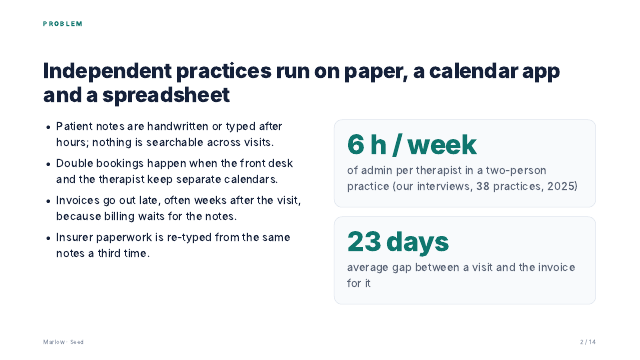

 pitchera.ai
Scan to view this report on another device
AI-Powered Pitch Deck Analysisv0.33.107
Questions? [email protected]
Like what you see?
Get the same report for your own deck: $49, one payment, ready in about 15 minutes. 14-day money-back guarantee.
Get Deep Analysis for my deck →Not ready to pay? Start with the free review.
The positioning insight is strong - physiotherapists, chiropractors and osteopaths outnumber dentists yet lack the software dentists have had for twenty years - but the slide presents only a EUR 4.2bn TAM for all European healthcare practice management, which is far broader than the segment you sell to.
Without SAM and SOM there is no way to judge whether your reachable revenue justifies venture scale.